


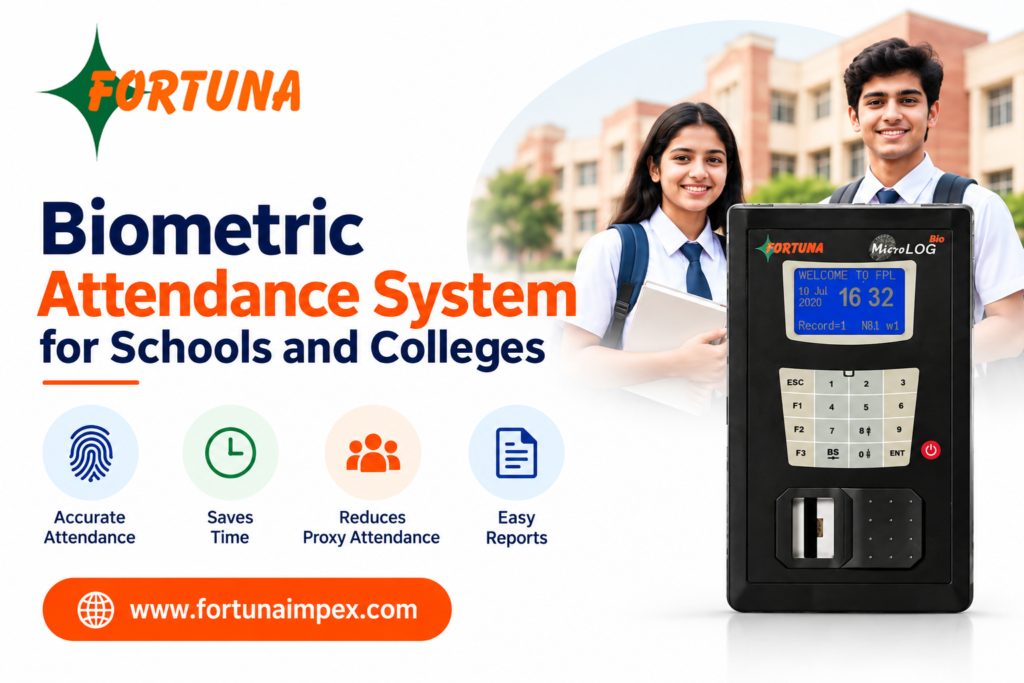
Managing attendance is an essential responsibility for teachers in schools and colleges. However, manually marking attendance, maintaining registers, correcting errors, and preparing attendance reports can consume valuable teaching time. These routine tasks can become even more challenging when educational institutions have hundreds or thousands of students.
A Biometric Attendance System for schools offers a modern solution by automating attendance tracking and reducing the workload associated with traditional attendance methods. Similarly, a Biometric Attendance System for colleges helps educational institutions maintain accurate attendance records, improve administrative efficiency, and create a more organized learning environment.
Fortuna Impex provides biometric attendance and access control solutions designed to support institutions in managing attendance more efficiently.
1. Saves Teachers’ Valuable Time
Traditional attendance management requires teachers to call students’ names, mark their presence in registers, and update records regularly. This process can take several minutes in every class.
A biometric attendance system automates the process by recording attendance through fingerprint or facial recognition, depending on the installed technology. This reduces repetitive administrative work and allows teachers to spend more time explaining lessons, interacting with students, and conducting classroom activities.
2. Improves Attendance Accuracy
Manual attendance records can contain errors caused by incorrect entries, missed names, or duplicate records. These mistakes can create difficulties when preparing attendance summaries or checking students’ eligibility for examinations.
A biometric system records attendance electronically and associates each entry with a registered individual’s biometric identity. This helps reduce manual errors and provides a more reliable record of student attendance.
For schools and colleges, accurate attendance information supports better recordkeeping and more informed administrative decisions.
3. Reduces Proxy Attendance
Proxy attendance occurs when one student marks attendance on behalf of another. Traditional paper-based methods may make this difficult to identify consistently, particularly in large classrooms.
A biometric attendance system verifies a student’s registered fingerprint or facial features before recording attendance. This makes it more difficult for students to register attendance on behalf of absent classmates.
As a result, educational institutions can strengthen attendance monitoring and encourage greater accountability among students.
4. Simplifies Attendance Reports
Preparing daily, weekly, or monthly attendance reports manually can be time-consuming for teachers and administrative staff.
A digital biometric attendance solution can store attendance records electronically and provide reporting features, depending on the system’s capabilities. Authorized staff can use these records to review attendance patterns, identify frequent absences, and prepare reports more efficiently.
For colleges with multiple departments and large student populations, centralized attendance records can make routine reporting considerably easier.
5. Helps Teachers Identify Students With Frequent Absences
Regular attendance plays an important role in students’ academic progress. However, identifying students who frequently miss classes can be challenging when attendance registers are maintained separately.
With an appropriate attendance management system, teachers and administrators can review attendance histories and identify students who may require additional attention.
They can then communicate with students or parents, understand the reasons for repeated absences, and take suitable steps to encourage regular attendance.
6. Supports Better Attendance Management Across Departments
Schools and colleges often have multiple classes, departments, buildings, and teaching schedules. Managing attendance records across these different areas can create additional administrative responsibilities.
A suitable biometric attendance solution can help institutions maintain more organized digital records. Depending on the system’s configuration, administrators may be able to access attendance information from a centralized platform and manage records across different departments.
This can improve coordination between teachers, department heads, and administrative teams.
7. Reduces Paperwork and Administrative Workload
Maintaining physical attendance registers requires paper, storage space, and regular manual updates. Finding older records can also be difficult when documents are stored in different locations.
A biometric attendance system digitizes attendance recording, helping institutions reduce dependence on paper registers. Electronic records can also make it easier for authorized personnel to retrieve information when required.
By reducing repetitive paperwork, teachers and administrative staff can focus more effectively on their core responsibilities.
8. Strengthens Attendance Monitoring and Accountability
Consistent attendance monitoring helps educational institutions establish clear expectations for students and staff.
A biometric attendance system creates electronic attendance records that can support institutional policies and reporting procedures. When integrated with suitable software, it may also support notifications, attendance summaries, or other administrative workflows.
Institutions should choose a solution that matches their attendance policies, reporting requirements, and existing technology infrastructure.
What Should Schools and Colleges Consider Before Choosing a Biometric Attendance System?
Before investing in a biometric attendance solution, educational institutions should evaluate the following factors:
- Recognition technology: Choose fingerprint or facial recognition based on the institution’s needs and operating environment.
- Capacity: Ensure the system can accommodate the expected number of students and staff.
- Reporting features: Check whether the solution supports the required attendance reports and record retrieval.
- Software integration: Determine whether it can work with existing student management or attendance software.
- Data security: Review access permissions, data protection measures, retention policies, and applicable privacy requirements.
- Ease of use: Select a system that teachers, administrators, and students can use with minimal training.
- Technical support: Consider installation assistance, maintenance, and after-sales service.
A careful evaluation helps institutions select a practical solution that supports their daily attendance management needs.
Why Choose Fortuna Impex for Biometric Attendance Solutions?
Fortuna Impex offers biometric attendance and access control solutions for organizations looking to improve identity verification and attendance management.
Educational institutions exploring a Biometric Attendance System for schools or a Biometric Attendance System for colleges should evaluate the available devices, software compatibility, reporting capabilities, and support options before making a decision.
Choosing an appropriate solution can help reduce manual attendance work, improve record accuracy, and support more efficient administrative processes.
Attendance management should support education rather than take valuable time away from it. By automating routine attendance recording, a biometric attendance system can help teachers save time, reduce manual errors, discourage proxy attendance, and maintain more organized records.
Whether an institution is a small school or a large college, adopting a suitable biometric attendance solution can be a practical step toward more efficient campus administration.
Fortuna Impex can help educational institutions explore biometric attendance and access control solutions suited to their operational requirements. With the right technology in place, teachers can spend less time on repetitive paperwork and more time helping students learn and succeed.

